Key takeaways
- Electric heaters can supplement gas central heating without requiring homeowners to replace their existing boiler or heating system.
- Room-by-room electric heating makes it possible to add heat only where and when it is needed.
- European gas markets are under renewed pressure ahead of winter 2026/27, with lower storage levels and substantially higher wholesale gas prices.
- Mill Smart WiFi heaters can automatically lower temperatures when you are asleep or away and restore the desired temperature before you return.
- Independent simulations conducted with the Norwegian University of Science and Technology (NTNU), according to Mill, show energy savings of up to 30% compared with traditional electric panel-heater operation.
Why are European households worried about gas this winter?
Europe enters the 2026/27 heating season with greater uncertainty around natural gas than in recent years.
In late September, European gas storage was around 70% full, approximately 12 percentage points below the same point in 2025. Around 80% of the EU’s gas is imported, leaving the region exposed to international supply disruptions and competition for LNG. European wholesale gas prices have also risen sharply during 2026.
This does not mean that European households are certain to face gas shortages. Europe’s supply system is more diversified than it was during the 2022 energy crisis, and additional LNG import capacity has improved resilience.
However, lower inventories, higher prices and uncertainty around global LNG supply mean that reducing unnecessary gas consumption can be valuable for households this winter.
One practical way to do that is to use electric heaters as a supplement to central heating.
Can electric heaters supplement gas central heating?
Yes. An electric heater can be used alongside an existing gas central heating system, allowing you to add heat to individual rooms without replacing your boiler.
This can be particularly useful in homes where central heating does not provide the same level of comfort everywhere.
A home office may feel cold during working hours.
A living room may need additional heat in the evening.
A bedroom may require heat only before bedtime and in the morning.
Instead of turning up the thermostat for the entire central heating system, you can use an electric heater to provide additional warmth where it is needed.
This means households can reduce their dependence on gas without committing to a major renovation or replacing their existing heating infrastructure.

Is room-by-room heating more efficient?
Room-by-room heating can reduce unnecessary energy use by allowing different parts of the home to be kept at different temperatures.
Consider a family that spends most of the evening in the living room.
There may be little reason to maintain the same temperature in an unused home office, guest bedroom and hallway.
With individual electric heaters, each room can have its own temperature schedule. The home office can be warm during working hours, bedrooms can be cooler during the day, and the living room can reach a comfortable temperature before the family returns home.
The principle is simple:
Heat the rooms you use, when you use them.
This is one of the main advantages of using electric heating as a supplement to central heating.
Are electric heaters as inefficient as people think?
Direct electric heating is often described as inefficient, but this can oversimplify how energy is actually used inside a home.
An electric resistance heater converts essentially all of the electricity it consumes into heat at the point of use. That does not mean it will always be the cheapest heating technology, because gas and electricity prices vary between markets and heat pumps can produce substantially more usable heat per kilowatt-hour of electricity.
However, real household energy consumption depends on more than the efficiency of the heat source.
The temperature you choose, the number of rooms you heat, how long you heat them and how accurately the heating is controlled can all have a significant impact.
For several decades, Swedish energy authorities have collected statistics on energy use in single-family homes. The figures show that homes heated with panel heaters and electric underfloor heating use 82 to 87 kWh per square metre for hot water and space heating. Comparable homes with direct electric heating and air-to-air heat pumps use 70 to 75 kWh per square metre. These figures indicate energy savings from heat pumps, although the difference is smaller than many people might expect. Installing a system that requires boreholes, water-based heat distribution and a heat pump can, however, cost several hundred thousand kroner.
Direct-acting electric heating makes it easy to heat only the rooms that are actually in use. In older homes with many rooms, this results in much lower energy consumption than what the theoretical calculation models suggest.
The same supplied research also references Norwegian NMBU data showing substantial differences between calculated energy consumption used in building energy ratings and the energy actually measured in homes.
These figures do not prove that direct electric heating is universally more efficient than other heating systems. But they do show why real-world energy use cannot always be understood from theoretical heating-system efficiency alone.

How can smart electric heating reduce energy consumption?
Traditional electric heaters generally respond to a thermostat: they switch heating on when the room becomes too cold and off when the target temperature is reached.
Smart heating adds another layer of control.
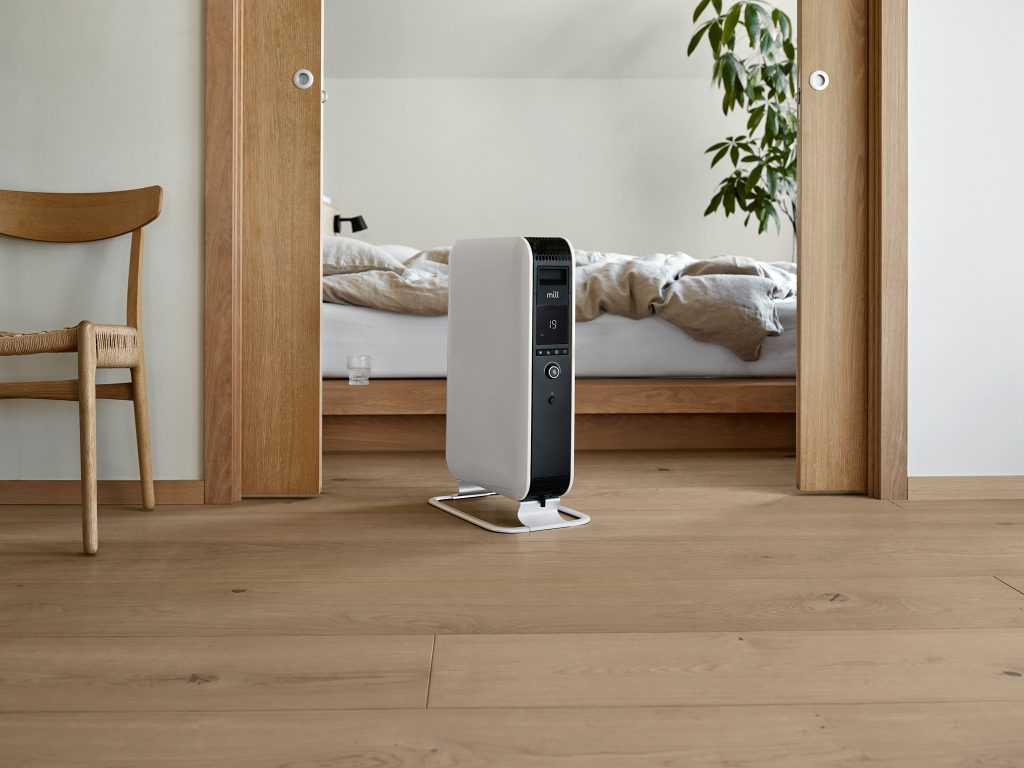
Mill Smart WiFi heaters can be programmed around the household’s daily routines through the Mill app.
For example:
The temperature can automatically be lowered after the family leaves home in the morning.
Bedrooms can remain cooler during the day.
The living room can start warming before everyone returns.
And temperatures can automatically fall again during the night.
This removes one of the biggest sources of unnecessary heating: maintaining the same temperature throughout the day regardless of whether anyone is using the room.

How much energy can Mill smart heaters save?
According to Mill, independent simulations conducted together with NTNU show that Mill Smart WiFi heaters can reduce energy consumption by up to 30% compared with traditional electric panel heaters.
The savings come from a combination of precise temperature control, weekly scheduling and app-based temperature management.
The important distinction is that the heater is not creating additional heat from the same electricity.
Instead, smart controls aim to reduce unnecessary heating.
Mill PID Wattage Tech™ adjusts the heater’s output as it approaches the desired room temperature rather than relying only on traditional full-power on/off operation. Mill Predictive Heating™ learns how quickly a room heats and cools so that it can calculate when heating should begin to reach the desired temperature at the scheduled time.
The Mill app also allows users to monitor temperatures and electricity consumption remotely.

Can you lower the temperature while away without coming home to a cold house?
Yes. This is one of the main advantages of scheduled smart heating.
A household does not need to choose between heating an empty home all day and returning to cold rooms.
With a heating schedule, the temperature can remain lower while nobody is home and begin increasing before people return.
For example, if you want the living room to be 21°C at 17:00, Mill Predictive Heating™ can learn how long that particular room normally takes to warm up and begin heating accordingly.
The same principle can be used overnight.
A bedroom can automatically cool after bedtime and warm again before the household wakes.
The goal is to provide the desired temperature when the room is actually being used, rather than maintaining it continuously.
Gas heating vs electric heating: does it have to be one or the other?
No.
For many homes, particularly during a period of uncertain gas prices, a hybrid approach may be the most practical.
The existing gas central heating system can continue providing baseline heating, while electric heaters provide additional temperature control in selected rooms.
This approach can offer several practical advantages:
Reduced reliance on gas. Individual rooms can be heated electrically when required, reducing the need to increase gas central heating throughout the home.
Room-by-room control. Different rooms can have different temperatures and schedules.
No full heating-system replacement. Electric heaters can supplement existing central heating without replacing the boiler, pipes or radiators.
More precise heating schedules. Temperatures can automatically fall when occupants are away or asleep.
Energy monitoring. Smart heating apps can make electricity consumption easier to see and understand.
Greater comfort. Rooms can reach the desired temperature before they are needed.
Should I switch from gas to electric heaters?
For most households, the more useful question is not whether to abandon gas completely.
It is:
Could I use less gas by heating some rooms electrically instead?
The answer depends on your home, electricity and gas tariffs, insulation, occupancy patterns and existing heating system.
For a household that already has gas central heating, replacing the entire system may involve significant cost and installation work.
Adding one or several electric heaters is much simpler.
They can provide additional heat in cold rooms, allow more precise room-by-room control and create an alternative source of space heating during periods when households want to reduce gas consumption.
What is the best way to use electric heaters alongside central heating?
The most efficient approach is generally to avoid using electric heaters simply to increase the temperature everywhere.
Instead, use them selectively.
Identify the rooms where additional warmth is most valuable.
Create schedules based on when those rooms are occupied.
Reduce temperatures automatically when rooms are empty.
And monitor consumption so you can see how different temperature settings affect electricity use.
Smart control makes this process easier because it can happen automatically rather than relying on somebody remembering to adjust every heater manually.
More control over your heating this winter
Europe’s gas situation remains uncertain heading into winter 2026/27.
That does not mean households need to replace their heating systems or make dramatic changes.
A more practical option may be to create greater flexibility.
By supplementing central heating with smart electric heaters, households can decide which rooms to heat, when to heat them and what temperature each room should have.
For Mill users, smart schedules, Predictive Heating™, PID Wattage Tech™ and consumption monitoring provide additional ways to manage that heating automatically.
When nobody is home, the temperature can fall.
Before the family returns, the rooms that matter can warm up again.
And when winter arrives, the goal is simple: use heat where you need it, avoid wasting it where you don’t, and stay comfortable while keeping greater control over your energy consumption.
Sources and References
European gas market
Reuters. EU warns of energy price crisis as Europe enters winter with lower gas storage levels. September 2026.
Used for information on European gas storage, gas import dependency and current market conditions.
Real-world energy consumption in Scandinavian homes
Swedish Energy Agency / Energimyndigheten. Energistatistik för småhus.
Historical statistics on energy consumption in detached houses using different heating technologies, including direct electric heating and air-to-air heat pumps.
NMBU – Norwegian University of Life Sciences. Research on calculated versus measured energy consumption in Norwegian residential buildings.
Used to illustrate differences between theoretical energy performance calculations and measured household energy consumption.
Smart electric heating
Mill International AS. Leading Technology – Mill Predictive Heating™, PID Wattage Tech™ and smart heating functionality.
Used for information about Mill smart heating technology, temperature scheduling and energy management.
Mill International AS. Mill Smart WiFi heaters and Mill app.
Used for information about room-by-room heating control, remote temperature management and energy consumption monitoring.
Energy-saving claim
Mill International AS / Norwegian University of Science and Technology (NTNU).
According to Mill, independent simulations conducted together with NTNU show that Mill Smart WiFi heaters can reduce energy consumption by up to 30% compared with traditional electric panel-heater operation. MILL wifi Heaters with Advanced PID Technology: A simulation-based test – Norwegian Research Information Repository