Oil-filled warmth is gentle and does not dry the air, which makes it ideal for the rooms you want genuinely comfortable rather than merely warm. It is also a better choice if you are sensitive to dry air.
The Mill Gentle Air’s closed structure speeds up warm-air circulation. WiFi models also let you control temperatures remotely, create heating schedules and monitor room temperatures and electricity consumption in the Mill app. This gives you room-by-room control, so you can plan heating around when each space is used.
Rather than firing up the central heating for the whole house, move the oil-filled radiators into the rooms where you need some extra warmth.
What is an oil-filled radiator and how does it work?
An oil-filled radiator is an electric resistance heater with thermal oil sealed inside. Electricity warms the oil and the metal body, which then releases heat into the room. The oil is permanently enclosed and does not need topping up. Because the radiator stores heat, it continues to feel warm for a period after the heating element switches off.
Unlike a fan heater, an oil-filled radiator does not rely on a fan to push heated air around. It typically provides gentler, quieter heat over longer periods, though initial warm-up can take longer.

What makes Mill Gentle Air different?
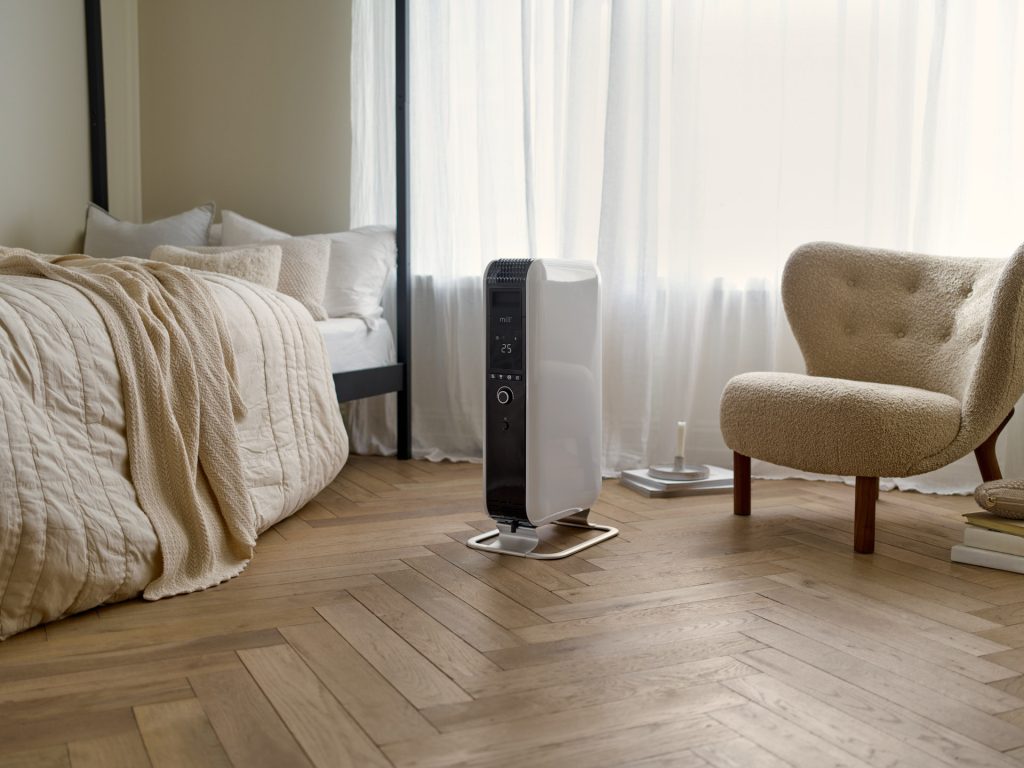
Traditional oil-filled radiators can take time to warm a room. Mill Gentle Air addresses this with Mill Heat Boost Technology™, a closed construction that accelerates the upward flow of warm air. According to the SGS testing cited in this article, this design heats a room 29% faster than traditional oil-filled radiators.
Designed in Norway, Mill Gentle Air combines minimalist side panels with a distinctive aluminium base for a streamlined look that complements modern interiors. Instead of wheels, it has an elegant base that forms part of Mill’s signature design. Side handles make it easy to carry between rooms when you need warmth elsewhere. Fan-free operation makes it particularly well suited to quiet spaces.
Key benefits at a glance
Quiet operation: no continuous fan noise while working, reading or sleeping.
Even, lingering warmth: thermal oil stores and gradually releases heat.
Faster room heating: 29% faster warm-up versus traditional oil-filled radiators (tested by SGS).
Flexible placement: a portable option for supplementary heating where it is needed.
Smart control on WiFi models: schedules, remote adjustments and electricity-use visibility in the Mill app.
You can safely leave it on during the night or unattended when following the safety instructions.
Safety features: tip-over protection, overheat protection and a child safety lock.
Looking for quiet, steady warmth for your bedroom, living room or home office?

Does an oil-filled radiator dry the air?
An electric radiator does not directly remove moisture from the air. However, warming air can lower its relative humidity, and people may perceive the room as drier. Because Gentle Air has no fan constantly blowing air, it avoids the airflow associated with fan heaters. The heating element is not in contact with the air, so it does not burn dust. These are the reasons for its gentle warmth suitable for people seeking a comfortable indoor environment.
How much electricity does Mill Gentle Air use?
Oil-filled heaters convert electricity into heat like other resistance heaters; the main opportunities to avoid unnecessary use are accurate temperature settings and heating only when needed.
A 2,000 W heater does not necessarily use 2 kWh of electricity every hour. It only does so when running continuously at full power. Mill Smart WiFi heaters use full power to warm the room, then regulate heating to maintain the chosen temperature rather than running at maximum power all the time. In the study, average power use was equivalent to approximately 15–30% of the heater’s maximum output under the tested conditions.* Depending on operating conditions and heating requirements, the documented energy consumption for Mill heater is about 5 kWh per m² per month.*
How does Mill Gentle Air WiFi smart control work?
Use heating schedules on the WiFi version to lower the temperature during periods when a room is usually unoccupied. This helps avoid heating the room more than needed.
Use the Mill app to adjust temperatures remotely, create daily schedules for individual rooms, view electricity consumption and manage heaters across multiple rooms or homes. For example, schedule your bedroom to be warm before you wake up and cooler during the day, while heating your home office mainly during working hours.
Mill Predictive Heating™ learns how a room warms up and cools down, allowing heating to start in advance so the room reaches its scheduled temperature on time. Open-window detection helps avoid unnecessary heating when a window is open. Eco Mode helps manage electricity use, while Wattage Cap lets you limit the heater’s power draw.
The Mill Gentle Air WiFi models are Matter compatible as well as compatible to Homey.

Which Mill Gentle Air size should I choose?
Power rating | Manufacturer-stated room size |
1,000 W | Up to 16 m² |
1,500 W | Up to 22 m² |
2,000 W | Up to 28 m² |
Available colors: black and white. These area recommendations are indicative; required heating power varies with insulation, ceiling height and climate.
Is it suitable for bedrooms and home offices?
Yes. The silent operation, safety features and the gentle warmth, make Mill Gentle Air a practical option for bedrooms, guest rooms, studies and home offices. Room-by-room heating is useful when only one space is occupied. A fan heater may be more suitable for a quick burst of heat; an oil-filled radiator is often a better fit for quiet, longer-lasting comfort.
Is Mill Gentle Air safe for overnight and unattended operation?
Gentle Air is equipped with tip-over switch, overheat protection and child safety lock. The heating element is encapsulated. For these reasons, the heater is safe for overnight and unattended operation.
Follow the specific model’s instructions for positioning, clearance and unattended operation. Never cover an electric heater or assume safety features eliminate all risk.
Frequently asked questions
Do oil-filled radiators need oil refills?
No. The thermal oil is sealed inside the radiator and is not intended to be replaced or refilled.
Do they keep heating after being switched off?
They continue releasing stored heat as they cool, but do not generate new heat after power is switched off.
Are oil-filled radiators cheaper to run than fan heaters or convection heaters?
Not inherently at the same electrical power and runtime. Costs depend mainly on wattage, duration, thermostat behavior and electricity prices. However, the wifi models are equipped with smart technology that is 30 % more energy efficient than non-wifi models*. The energy efficiency is related to the smart technology and not the heating technology as all direct heaters delivers a 1 to 1 conversion.
Can Mill Gentle Air connect to a smart home?
The WiFi models support app control, Matter and Homey compatibility.
Why does not Mill Gentle Air have wheels?
Mill Gentle Air has side handles so you can carry it between rooms. Its distinctive feet are an integral part of the modern, streamlined design, giving it a different appearance from traditional oil-filled radiators with wheels.
Bottom line
Choose Mill Gentle Air if you want stylish, quiet supplementary heating with steady, comfortable warmth. Its distinctive heat-distribution design helps warm the room faster, while WiFi models add smart controls to help manage heating and avoid unnecessary electricity use. Match the power rating to your room, use the thermostat thoughtfully and follow the manufacturer’s safety guidance.
*Source: Heating simulation Dec. 2022 – Norwegian University of Science and Technology